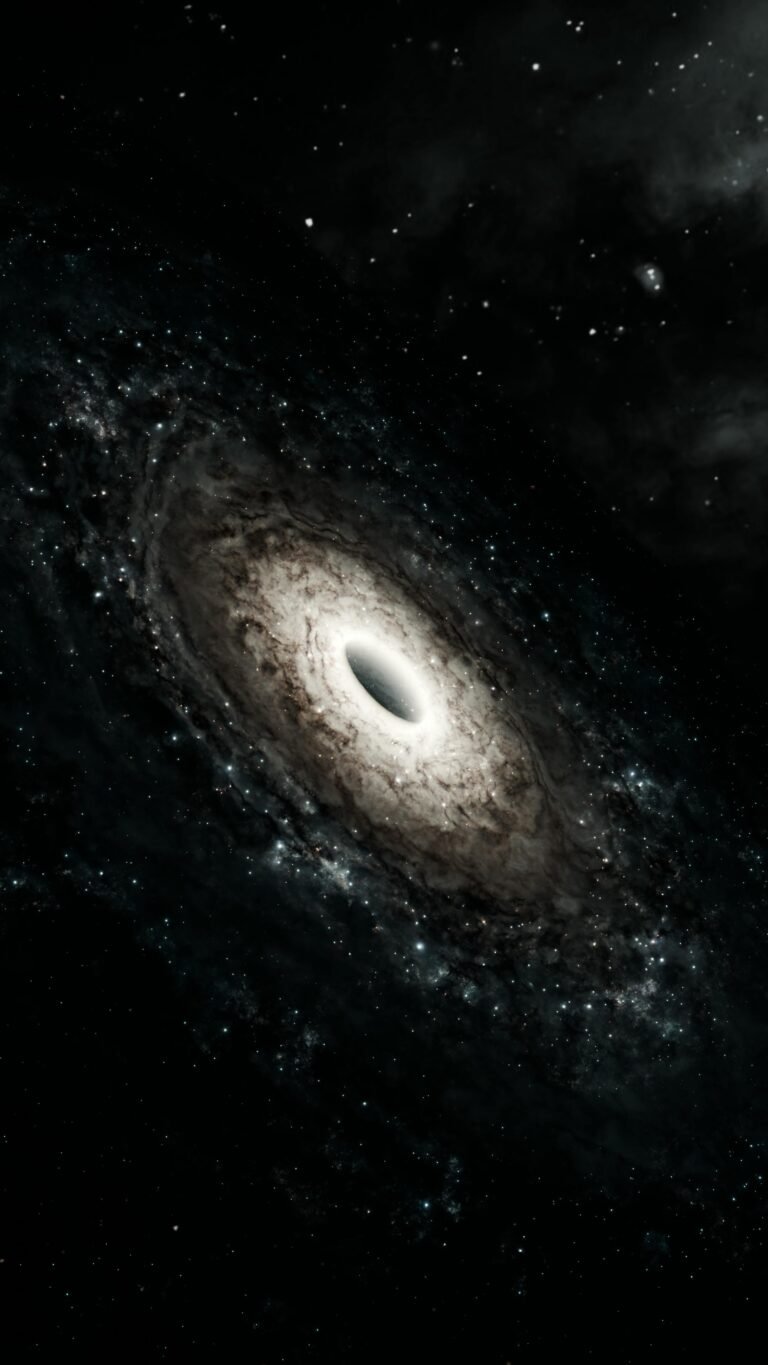






In the intersection of general relativity and quantum mechanics, Hawking Radiation represents one of the most profound theoretical discoveries of the 20th century. Proposed by Stephen Hawking in 1974, it suggests that black holes are not truly “black” but emit thermal radiation due to quantum effects near the event horizon.
🌌 1. The Mechanism: Quantum Fluctuations
According to quantum field theory, “empty” space is not empty; it is filled with vacuum fluctuations—pairs of virtual particles and antiparticles that constantly pop into existence and annihilate each other almost instantly.
- Near the Event Horizon: If a pair of virtual particles is created exactly at the edge of a black hole’s event horizon, a unique phenomenon occurs:
- One particle (often modeled as having negative energy) falls into the black hole.
- The other particle (with positive energy) escapes into space.
- The Result: To an outside observer, the black hole appears to have emitted a particle. Because the black hole absorbed a particle with negative energy, its total mass decreases.
🌡️ 2. Temperature and Mass Relationship
Hawking radiation is thermal, meaning a black hole has a specific temperature ($T_H$). Crucially, this temperature is inversely proportional to the black hole’s mass ($M$):
$$T_H = \frac{\hbar c^3}{8\pi G M k_B}$$
- Large Black Holes: A black hole with the mass of the Sun would have a temperature of approximately 60 nK (nanokelvin), which is much colder than the Cosmic Microwave Background (2.7 K). Thus, they are currently gaining more mass from the universe than they are losing via radiation.
- Small Black Holes: As a black hole loses mass, its temperature increases. This leads to a runaway effect: the smaller it gets, the hotter it glows and the faster it evaporates.
⏳ 3. Black Hole Evaporation
The process of losing mass through radiation is called evaporation. The time it takes for a black hole to evaporate completely is proportional to the cube of its mass ($t \propto M^3$):
- Sun-sized Black Hole: Would take roughly $10^{67}$ years to evaporate—vastly longer than the current age of the universe.
- Subatomic Black Holes: If “primordial” black holes (the size of a mountain but the width of an atom) exist, they would be ending their lives today in a violent burst of high-energy gamma rays.
⚠️ 4. The Information Paradox
Hawking radiation introduces a major conflict in physics known as the Black Hole Information Paradox:
- Quantum Mechanics states that information about the physical state of a system must be preserved (Unitary).
- Hawking Radiation is purely thermal; it depends only on mass, charge, and spin, not on what fell into the black hole.
- The Conflict: If a black hole evaporates completely, the information contained within it appears to vanish from the universe, violating the laws of quantum mechanics.
🧪 5. Current Scientific Standing (2026)
While Hawking radiation has not been directly observed in space (due to its extreme faintness), it has been simulated in analog black holes using sound waves in extremely cold fluids (Bose-Einstein condensates) and fiber optics. These experiments consistently confirm the presence of spontaneous thermal emission as predicted by Hawking’s equations.
- Calculate the evaporation time for a specific mass
- Explain the Holographic Principle as a solution to the paradox
- Summarize recent analog black hole experiments